Rules and search data updated November 2026.
Most injury firm pages answer this question with one list. Don't say sorry, don't say you're fine, don't give a recorded statement. That list mixes up two calls. A driver who reads it may stonewall their own insurer and put their coverage at risk.
Do this instead. Split the answer in two. One part for the company the driver pays, and one for the company that insures the other car. Then give the words to use on each call. The driver gets a plan, and the firm that wrote it gets the call when the adjuster gets pushy.
Your Insurer vs Theirs
Your own policy is a contract you signed. It has a section called something like Duties After an Accident or Loss, and it is not optional. One specimen policy American Family filed with the Nevada Division of Insurance says it has no duty to cover you unless you fully comply with that section.2
Read clause h in the picture below. The insured must give written and recorded statements and answer questions under oath, as often as the company reasonably asks. That is a motorcycle form, but the duties section reads much the same way on many auto policies. Check the driver's own policy before you tell anyone to refuse.
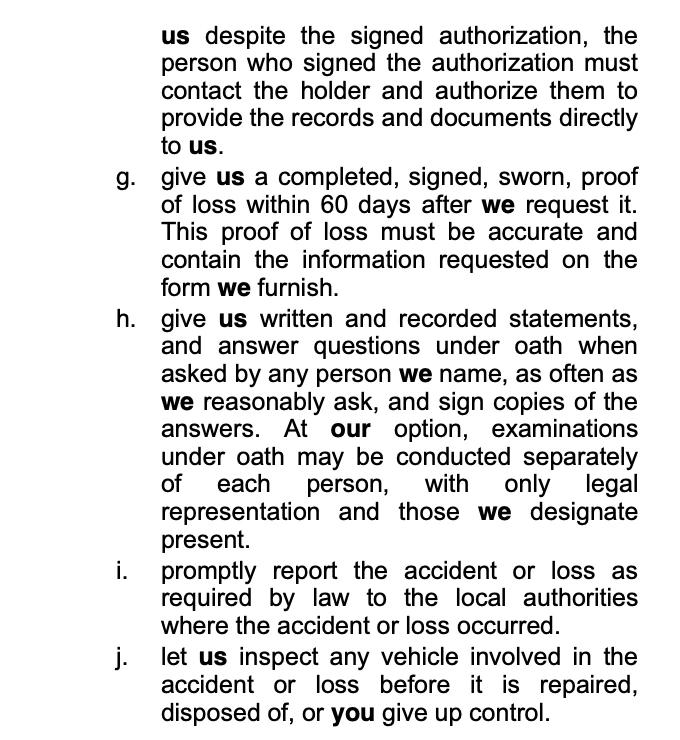
The California Department of Insurance says the same thing in plain words. Your insurer will contact you for details and may take a written or recorded statement. It can sometimes ask for an examination under oath.1
The other driver's insurer is a different story. You never signed anything with them. Their policy binds their driver, not you. You can keep that call short, ask for questions in writing, or let a lawyer handle it.
| Question | Your own insurer | The other driver's insurer |
|---|---|---|
| Is there a contract with you? | Yes, your policy | No |
| Must you report the crash? | Yes, promptly, with time, place, injured people and witnesses | No policy of yours asks you to |
| Recorded statement? | The policy may require it | Your choice. Writing or your lawyer is safer |
| Medical records? | The policy may require signed authorizations | Share only what the claim needs, best through a lawyer |
| Promise to pay anyone? | The sample policy says not to make promises that bind the insurer | Never |
Our table, built from the policy and state pages cited here. Policies differ, so read the duties section of the real one.
What Not to Say, Line by Line
On either call, the risk is the same. A guess turns into a fact in the file. These are the lines to drop, and what to say in their place.
- It was my fault. Say what happened in order instead. Where you were, which way you were going, what you saw. Fault is the adjuster's job and later maybe a court's.
- I was going about 30. Don't guess speed, distance or seconds. Say I don't know, or I'd have to check, when that is true.
- I'm fine. Say I'm getting checked out, and name the doctor visit if there is one. Pain from a crash can show up later.
- Your whole health history. Answer about this crash and these injuries. Old records are a question for your lawyer.
- Signed notes at the scene. The Department of Insurance tells drivers not to sign statements about fault or promise to pay for the other party's damage.1
- I'll cover it. The sample policy bars promises that would bind the insurer, and payments to others except at your own cost.2
Now the one most pages get wrong. The AI answer on top of Google for this search says a polite sorry is often read as an admission. In California that is only half true. Evidence Code 1160 says a statement or gesture that only shows sympathy can't be used as an admission of liability in a civil case. A statement of fault said with it can.3
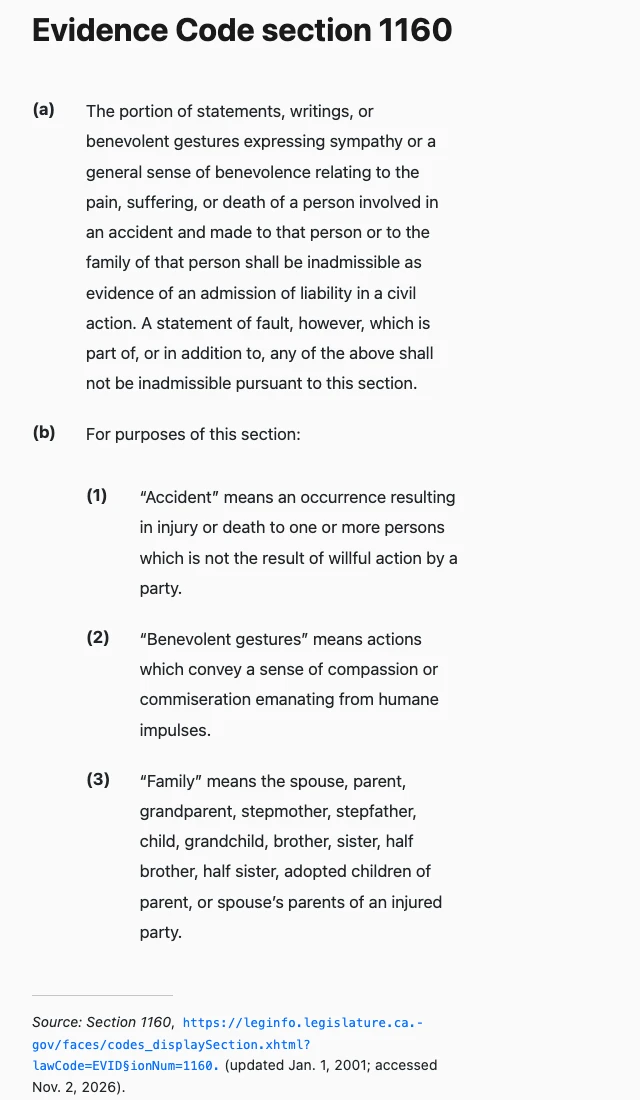
So the rule for a driver is simple. Kindness is fine. Blame is not. Other states have their own rules, which is a reason for a firm to write this page for its own state.
The Clocks That Start After a Crash
A driver who knows the deadlines feels less pushed on the phone. California sets several of them. Some come from the state, and some come from the policy.
Days on the Clock After a California Crash
From the DMV, the Department of Insurance and the sample policy cited here.
The DMV says a driver must send an SR-1 within 10 days if anyone is hurt, even slightly, or property damage is over $1,000. It is required on top of any report to police, the CHP or the insurer.4 Even the Department of Insurance guide, revised December 2024, still lists $750 as the trigger.1 Go by the DMV page, and catch that kind of drift on your own site too.
The same guide sums up the fair claims rules. The insurer must acknowledge the claim and start its investigation within 15 days of notice. It must answer your messages within 15 days, and accept or deny the claim within 40 days after proof of claim.1 Proof of claim means papers like a repair estimate or a police report.
Why do adjusters ask so many careful questions? Look at the money. The average bodily injury liability claim was $28,278 in 2024, and the average property damage liability claim was $6,770.5 A few words on a recorded line can move a number that size.
Who Holds This Search in November 2026
Look at the field before you write. Our DataForSEO pull of Google for what not to tell your insurance company, United States, November 3, 2026, put an AI answer on top with 11 linked references. Below it, 7 of the 8 plain results were law firm pages. The eighth was the NAIC consumer page.
Most of those firm pages give one list for both insurers. Few show a real policy clause, a table of state clocks, or the line between sympathy and fault. That is the gap. A firm that fills it has the most useful page on the first screen.
The demand is small, and the clicks are costly. Our Google Ads numbers for the United States, monthly averages from October 2025 to September 2026, show 70 searches a month for what not to say to insurance adjuster, peaking at 110 from March to May 2026. What not to say to insurance after accident drew 40 a month at a $39.12 average cost per click, with top of page bids up to $85.32. What not to tell your insurance company averaged 10 a month but hit 50 in September 2026.
Firms pay close to $40 a click for these searchers because they are people in the first days after a crash. A page that earns the same visit for free keeps paying every month.
Win the Driver Before the Adjuster Calls
Most firm pages try to scare the reader off every insurer. Skip that. Help the driver handle both calls well, and they will trust you with the hard part.
- Split the page by insurer. Put the table above near the top, with your state's rules filled in. The content brief lesson shows how to build the outline from the questions people ask.
- Write the scripts. Three or four lines a driver can read off the phone. I'm getting checked out. I don't know the speed. Please send your questions in writing. Short lines get used.
- Teach them to find their duties section. Tell the reader to open their policy and look for Duties After an Accident or Loss. Show a real clause, like the one above, so they know what it looks like.
- Name your state's rules. Your sympathy rule, your crash report deadline, your fair claims clock. Link each one to the state page. A reader in another state should see right away that the page is not for them.
- Reach people the right way. In California, Rule 7.3 bars a lawyer from in person, live phone or real time contact to win a case for pay, with narrow exceptions. Comment 1 says a website or an ad aimed at the general public is not a solicitation.6 The Department of Insurance also warns that capping, paying for referrals of clients to law offices, is a felony in California.1 A page that answers the question is how a firm meets crash victims without breaking either rule.
- Put a licensed lawyer's name on it. Google's guide to helpful, people first content asks whether it is clear who wrote a page and why they know the topic.7 The trust signals lesson covers the byline, the bar number and the photo.
- Link the next question. After the call comes the offer, and after the offer comes what the client keeps. Point readers to a page like our $20,000 settlement breakdown so the visit doesn't end on your site with nowhere to go.
Keep it fair to adjusters, too. Most are doing a job the policy and the state rules describe. Your edge is not that insurers are evil. It is that your page explained both calls, showed the real clause and named the deadlines.
Five Days to a Better Page
- Monday. Pull three real auto policies your clients have shared. Copy the duties section wording, with names taken out.
- Tuesday. Look up your state's sympathy or apology rule, your crash report rule and your fair claims deadlines. Save every link.
- Wednesday. Write the two column table and the phone scripts. Have a lawyer at the firm check every line.
- Thursday. Write the page. The split answer first, the table second, the scripts third, the clocks fourth. Add the lawyer's byline.
- Friday. Add the questions below in your own words, link the page from your car accident and contact pages, and submit it in Search Console.
Then watch which searches the page shows up for. Recorded statement questions and adjuster questions often come next. Give each one its own section once it brings visits.
This guide is part of the free Learn Clickflame course. Every lesson is free and uses free tools.
Questions Before You Start
Do I have to give a recorded statement to my own insurance company?
Often, yes. Many policies say you must cooperate, and some list written and recorded statements and answers under oath. Read the duties section of your own policy, and ask a lawyer if the claim involves injuries.
Do I have to talk to the other driver's insurance company?
You have no contract with the other driver's insurer. You can keep the call short, ask for questions in writing, or have your lawyer handle it.
Is saying sorry after a car accident an admission of fault?
In California, words that only show sympathy can't be used as an admission of liability in a civil case. A statement of fault said with them can. Other states have their own rules.
How long does an insurance company have to respond to a claim in California?
The Department of Insurance says the insurer must acknowledge the claim within 15 days of notice and accept or deny it within 40 days after proof of claim.
When do I have to report a car accident to the DMV in California?
Within 10 days if anyone is hurt or killed, or if property damage is over $1,000. The SR-1 is needed even if police or your insurer already have a report.
Can an injury lawyer call me after a car accident?
In California, a lawyer can't solicit your case by in person, live phone or real time contact for pay, with narrow exceptions. A website or a general ad is not a solicitation.