Figures and rules updated October 2026.
Most injury firm pages answer this question with a range. You may keep $8,000 to $12,000, it depends, call us. The person who searched is holding an offer letter. A range tells them nothing they can plan a rent check around, so they keep searching.
Do this instead. Walk the $20,000 down one line at a time, in the order the money really moves. Then point to the rule behind each line. The searcher gets an answer, and the firm that gave it gets the call.
Where the $20,000 Goes First
The check from the insurer goes to the lawyer's trust account, not to the client. From there it is paid out in a set order. The fee contract decides most of it, so read that first.
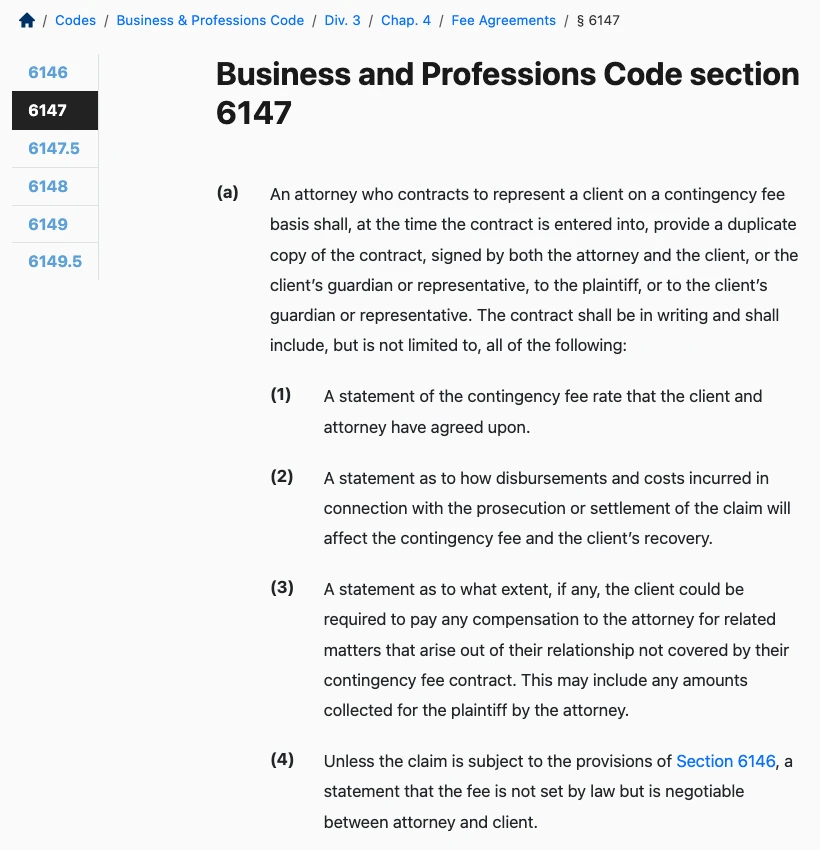
The fee. A contingency fee is a share of the recovery. In California the contract must be in writing and signed by both sides. It must state the rate, say how costs will affect the fee and the client's recovery, and say the fee is not set by law but is negotiable. A contract that skips any of this can be voided by the client, and the lawyer is left with a reasonable fee.1
The costs. These are what it took to work the case. Medical records, filing fees, a police report, sometimes an expert. On a small car case they may be a few hundred dollars. The contract says whether the fee is figured before or after they come out.
The medical money. Whoever paid the treatment may want it back. That can be a health plan, Medicare, Medi-Cal or a hospital holding a lien. This line moves the most from one client to the next, and it is the one firms explain least.
The client. What is left goes to the person who got hurt. In most cases that check is the reason they hired a lawyer.
A $20,000 Settlement, Worked Two Ways
These are worked examples, not a promise about any case. We used a one third fee because two of the law firm pages on Google's first page for this search used 33.3 percent and 40 percent in their own examples. Your real rate is the one in the signed contract.
| Line | Case A, health plan paid $5,000 | Case B, Medicare paid $6,000 |
|---|---|---|
| Gross settlement | $20,000 | $20,000 |
| Fee at one third of gross | minus $6,667 | minus $6,667 |
| Case costs | minus $600 | minus $600 |
| Medical payback | minus $5,000, no reduction assumed | minus $3,820, after the federal reduction |
| Client keeps | $7,733 | $8,913 |
Our worked example. A health plan may agree to a reduction too, and many do when asked. We left Case A at full payback so the gap is easy to see.
Case B shows a rule most pages skip. When Medicare pays for treatment, it gets repaid from the settlement through its Benefits Coordination and Recovery Center, which sends a formal demand once the settlement is reported. The report has to list the settlement date, the amount and the fees and costs the client paid.3
Then a federal rule cuts Medicare's claim. Under 42 CFR 411.37, divide the fees and costs by the total settlement. Multiply that ratio by what Medicare paid. Subtract the result from Medicare's claim.4 In Case B, $7,267 in fee and costs over $20,000 is a ratio of about 0.363. Times $6,000 that is $2,180, so Medicare is owed $3,820, not $6,000.
Where $20,000 Goes in Case B
Our worked example, one third fee, $600 costs, Medicare paid $6,000.
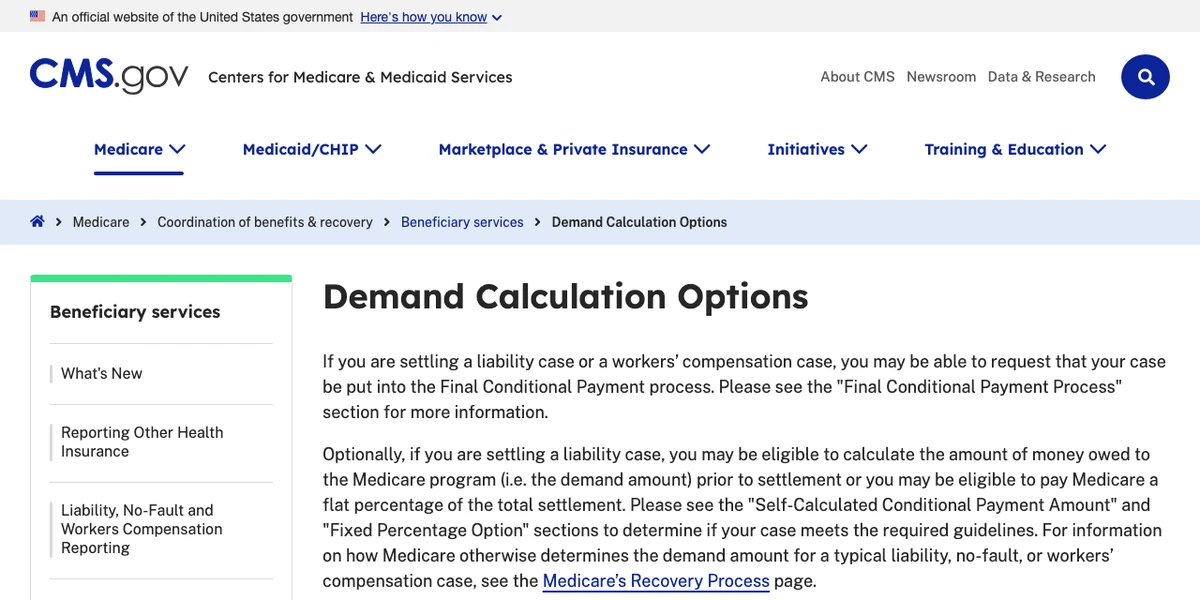
Size matters here too. CMS lets a client settling a liability case for $25,000 or less figure the Medicare amount on their own before settling. A flat payment option exists only for physical injury settlements of $10,000 or less, so a $20,000 case does not qualify for it.5
One more line can change the result. If the fee is taken after costs, the client keeps more. In our example a one third fee on $19,400 instead of $20,000 is $6,467, so the client keeps $200 more. That is the exact point California's contract rule makes the lawyer spell out.1
Hospital Liens, Taxes and the Other Surprises
Hospital liens in California. A hospital that treated the client can hold a lien on the recovery. California caps what the hospital can collect at what can be paid out of 50 percent of the money due under the judgment, compromise or settlement, with earlier liens paid first.6 Other states use other rules. A firm page should name its own.
Taxes. Federal law leaves out of income the damages, other than punitive damages, received on account of a personal physical injury or physical sickness. It does not count emotional distress as a physical injury, apart from money up to what was paid for medical care for it.2 So a car crash settlement for a broken wrist usually lands differently than a settlement for distress alone. A client with any doubt should ask a tax pro.
Averages. Clients ask what is normal. No one has a clean public answer, and a firm should say so. A Bureau of Justice Statistics study of 2005 state court tort trials found trials ended only about 4 percent of tort cases, and half of the winning plaintiffs at trial were awarded $24,000 or less. The same report notes that settlement terms are usually kept out of the public record.8 Any average settlement number on a law firm page did not come from a public court file.
Who Holds This Search in October 2026
An injury firm owner should see the field before writing a word. Our DataForSEO pull of the Google results for how much of a $20,000 settlement will I get, United States, October 28, 2026, looked like this.
- An AI answer sat at the top. Below it, four People Also Ask questions, among them what percentage a lawyer takes and whether 30k is a good car accident settlement.
- The first plain result was a Hawaii firm's page on a $25,000 settlement, dated August 1, 2025. It ran about 1,700 words, gave a $8,000 to $12,000 take home range and cited no statute.
- Eight of the nine plain results were law firm pages. The ninth was a software company's blog of settlement amount examples.
- Not one page we checked walked through the Medicare reduction formula or a state lien cap.
Then the links. In the same tool, we checked five of those pages for linking websites. Only the calculator page had any on record, and that was 1 site with a nofollow link. That is a weak field for a search where people hold real money.
The demand sits in the sister searches. Our Google Ads pull for the United States, monthly averages from October 2025 to September 2026, put how much of a 25k settlement will I get at 480 searches, with a top month of 880. What percentage does a lawyer take from a settlement and personal injury settlement calculator each averaged 720. The $20,000 wording was too small for Ads to give its own number, yet it still shows a full page of results. The 25k phrase carried an average cost per click of $43.09, so a page that wins this visitor for free saves real money.
Win the Search With a Closing Statement Page
Most firm pages on this question end in a phone number. The searcher wants a closing statement before they ever sign. Give them one, and stay inside your bar's ad rules while you do it.
- Lead with the line by line table. Gross, fee, costs, medical payback, client. Use round numbers and label it an example. The content brief lesson shows how to build the outline around the questions people ask.
- Say how your fee meets your costs. Before or after. If you are in California, the contract already has to say it, so say it on the page too.
- Name the rules in your state. Your lien statute, your fee rules, the Medicare formula. Link the statute itself. A page that cites the law reads like counsel, not an ad.
- Put the cost line next to no fee unless we win. California's Rule 7.1 says that claim is misleading unless the ad also says whether the client is liable for costs. The same rule says a guarantee of a result is misleading, and that past results can mislead without the facts of each case.7
- Turn it into a tool. A simple net calculator with fee rate, costs and medical payback fields is the kind of page other sites link to. The linkable asset lesson covers how to build and pitch one.
- Say who wrote it. Google's guide to helpful, people first content asks whether it is clear who wrote a page and whether it shows first hand expertise.9 Put the attorney's name and bar number on it. The trust signals lesson covers the rest.
Then use the table in the first meeting. A client who already saw the order of the money on your site asks better questions and trusts the closing statement when it comes.
Build It This Week
- Monday. Pull your fee contract and read the cost clause. Write it down in one plain sentence.
- Tuesday. Find your state's lien statute and your bar's advertising rule. Save both links.
- Wednesday. Build the worked example table at $20,000, then copy it for $25,000 and $50,000. Those are the sister searches.
- Thursday. Write the page. The answer first, the table second, the rules third. Have the attorney who signs your closing statements review it.
- Friday. Add the questions below in your own words, link it from your fees and contact pages, and submit it in Search Console.
Give it a month. Then look at which dollar amounts it shows for and add a table for each one that brings visits.
This guide is part of the free Learn Clickflame course. Every lesson is free and uses free tools. It is marketing guidance for firm owners, not legal advice.
Questions Before You Start
How much of a $20,000 settlement will I get?
It depends on your fee rate, the case costs and who paid your medical bills. In our worked example with a one third fee, $600 in costs and $5,000 to $6,000 in medical payback, the client keeps about $7,700 to $8,900. Your lawyer's closing statement gives the real number.
What percentage does a lawyer take from a settlement?
Whatever the signed contingency fee contract says. In California the contract must state the rate and must say the fee is not set by law but is negotiable, except in cases where the law sets a maximum.
Who gets paid first in a personal injury settlement?
The money goes to the lawyer's trust account first. The fee and costs come out under the contract, then medical payback such as Medicare, a health plan or a hospital lien, then the client gets the rest.
Is a $20,000 injury settlement taxed?
Federal law leaves out of income damages received for a personal physical injury or physical sickness, except punitive damages. Money for emotional distress alone is treated differently, so ask a tax pro about your case.
Does Medicare take a cut of my settlement?
If Medicare paid for your treatment, it must be repaid from the settlement. Federal rules reduce its claim by its share of the fees and costs you paid. In our $20,000 example that cut Medicare's claim from $6,000 to $3,820.
Should an injury firm post average settlement amounts?
Be careful. Settlement terms are usually not public record, so averages are hard to back up. California's Rule 7.1 also warns that past results can mislead without the facts of each case. A labeled worked example is safer and more useful.