The Short Answer for the Homeowner
We look at a lot of home service websites. Pest control pages are some of the worst at answering this question. Most say scams exist, tell you to read reviews, and ask for your zip code. So the plain answer comes first.
Pest control is not a rip off when you can check what you are paying for. Bed bugs, German roaches, termites and mice in the walls are hard to beat with store sprays. A good company finds where pests get in, treats the right spot, and tells you what it costs before it starts.
It turns into a rip off in four ways. A salesman knocks, says your neighbors signed up, and wants a signature tonight. Someone finds bugs you never saw and will not let you see them. A one time job becomes a year long plan that renews on its own and is hard to cancel. Or the tech you pay every quarter sprays the baseboards in ten minutes and never looks for how the pests get in.
The homeowner's fix is simple. Get the price in writing. Ask to see the pest, in person or in a photo. Look up the license. Never sign at the door. And read how the plan ends before you agree to how it starts.
What Pest Control Should Cost
You cannot call a price a rip off until you know what normal is. This Old House's pest control cost guide, updated March 12, 2026, gives these national ranges per visit.
- A one time treatment runs $50 to $500, with an average of $171.
- Ants run $100 to $500, cockroaches $100 to $600 and fleas $100 to $400.
- Mice and other rodents run $180 to $600 and wasps $300 to $700.
- Termites run $250 to $1,000. Bed bugs run $1,000 to $4,000, and tent fumigation runs $1,500 to $8,000.
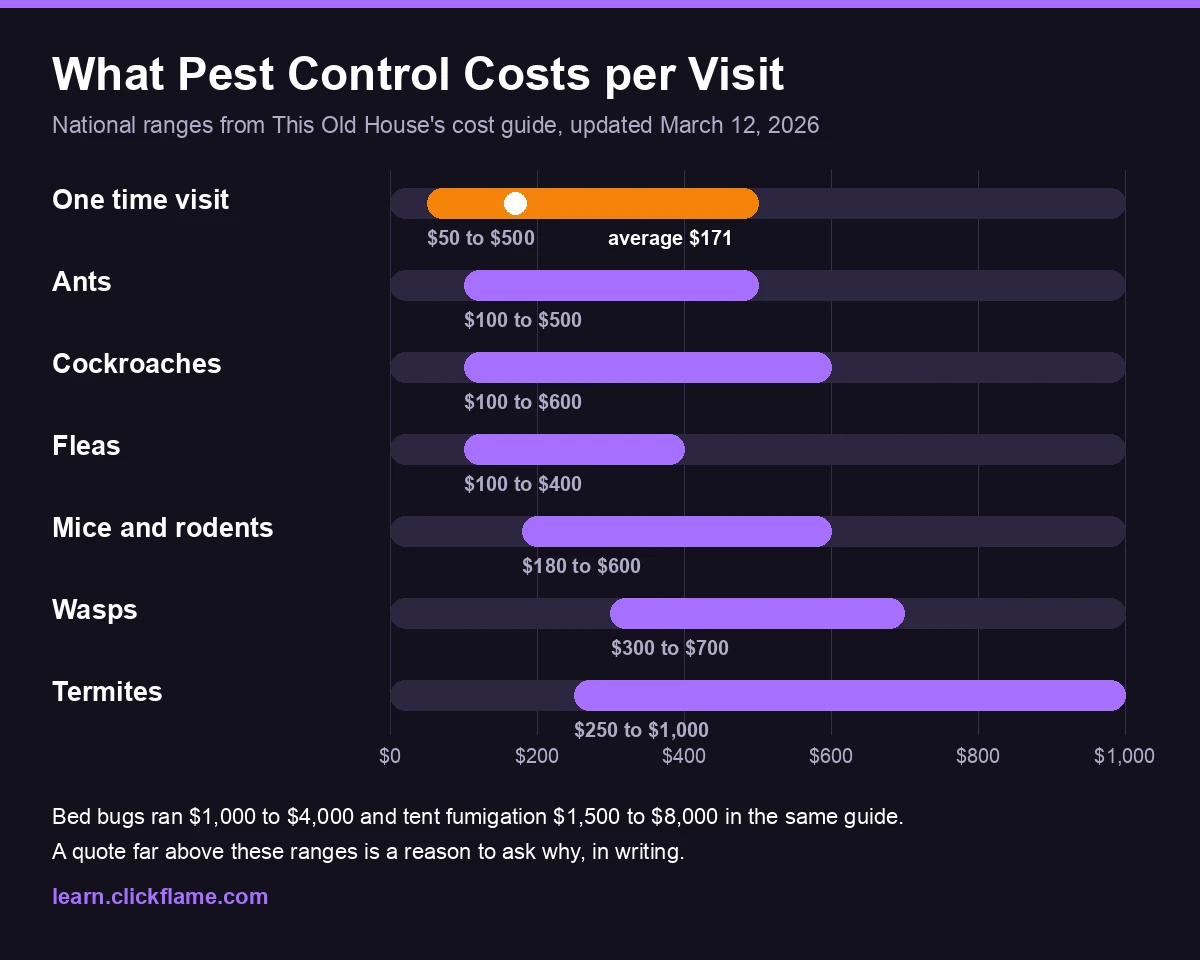
Keep those numbers in their place. The guide says its figures blend estimates from Angi, pest control companies and market research. A quote outside the range is a reason to ask why. It is not proof of a scam.
Is $50 a Month for Pest Control a Lot?
Not by itself. Compare it with one real plan. Better Termite and Pest Control in Northern Virginia lists its general plan from $49 a month, with a $200 first visit, three visits a year. The company works out the totals itself. That comes to $588 a year, or $788 the first year.
So a monthly price is really a yearly price. Multiply it by twelve, add the setup fee, and divide by the number of visits. If that number per visit sits far above the one time range above, ask what you get on top of the spray. Free callbacks between visits, sealing entry points or a written guarantee can be worth it. A ten minute baseboard spray is not.
Why Every Company Pushes a Plan
Homeowners feel the push toward a contract, and they are right. It is how the business is built. The National Pest Management Association reported on April 1, 2026 that recurring service made up 85.4 percent of residential pest control revenue in 2025. The same study counted 16,565 pest control firms, and 81.4 percent of them run one or two locations.
A plan is not a scam. Plenty of homes in warm, wet places need regular service. But a homeowner who calls for one wasp nest and leaves with a year long contract will search for this question that night. The company worth hiring is the one that says when a one time visit is enough.
The Three Day Rule for Door to Door Deals
Most top pages skip this rule. The Federal Trade Commission's Cooling-Off Rule, on a page dated September 2025, covers sales of $25 or more made at your home. It works like this.
- You can cancel until midnight of the third business day after the sale, with no reason given. Saturdays count. Sundays and federal holidays do not.
- The seller must tell you about that right at the time of sale and give you two copies of a cancellation form, plus a dated copy of the contract with the seller's name and address.
- To cancel, sign and date one form and mail it before the deadline. If you got no form, write a letter. The FTC suggests certified mail with a return receipt.
- Once you cancel, the seller has 10 days to refund your money.
One catch matters for pest control. The rule does not cover a repair or service visit you asked for yourself. It does cover anything extra the tech sells you while he is there. So if you call for ants and sign a year long plan on the porch, the plan is covered. The FTC takes reports at ReportFraud.ftc.gov, and some states give buyers more time than the federal rule.
The License Check Takes Two Minutes
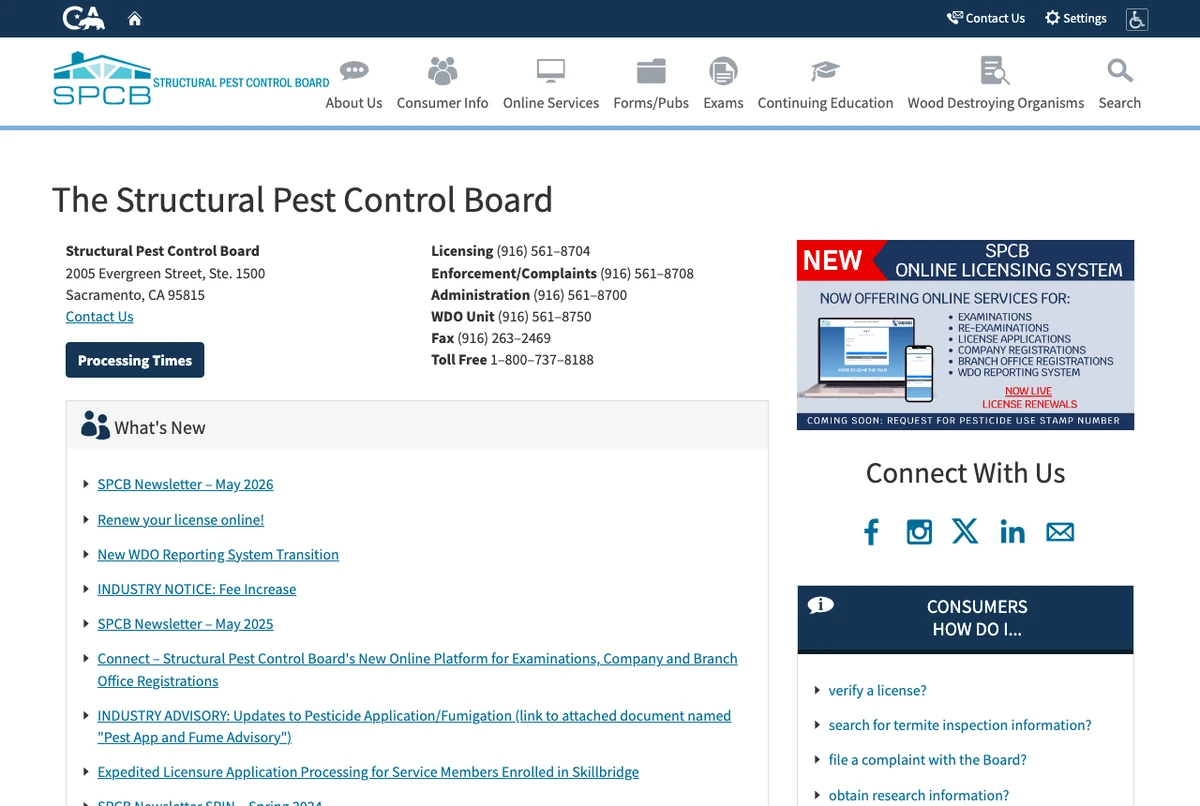
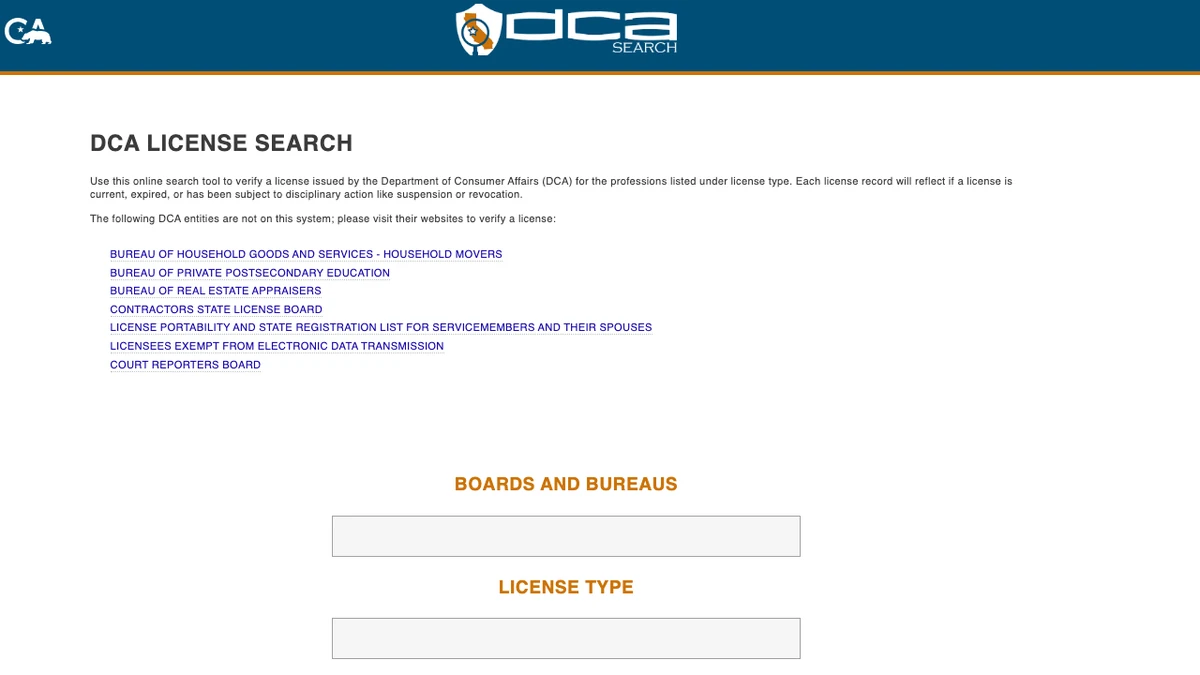
Start with your state's pest control regulator. Many let anyone check a company for free. In California, the Structural Pest Control Board sends homeowners to the state's DCA license search. Pick the board, then search by name, business name or license number. The board's license page notes that cancelled licenses do not show up in that search.
In Texas, the Department of Agriculture runs the Structural Pest Control Service. Its consumer page says a license is required for anyone in the business of pest control, from a one person shop to a big franchise, and it takes complaints by phone and email.
Each Rip Off, and the Proof That Beats It
The other pages leave out one thing. Every fear on this list has a matching piece of proof. A company that plays fair can put that proof on its own site before the homeowner ever calls.
| What the rip off looks like | What your site shows instead |
|---|---|
| A door knock and a deal that ends tonight | A line that you do not sell door to door, or that every quote holds for a set number of days |
| Bugs the homeowner never saw | A photo of what the tech found on every inspection, sent before any treatment |
| A price that keeps changing | Your one time price and your plan price per visit, side by side, in plain numbers |
| A plan that renews on its own and will not end | Your plan length, how to cancel, and how much notice you need, written on the plan page |
| A ten minute spray and gone | What a visit includes, how long it takes, and that the tech checks for entry points |
| No way to check the company | Your license number with a link to your state's lookup |
The left column comes from the pages ranking for this question and the rules linked above. The right column is our advice for your site. Fill it with your real prices and your real terms, never made up ones.
What the Search Page Looked Like on October 20, 2026
Before you write, look at who you have to beat. We pulled the live Google results for this exact question on October 20, 2026. This is our own pull, from DataForSEO, United States results.
- Google showed an AI answer first. It leaned on Reddit, Angi, two senior services sites and a pest company blog. It also cited TikTok, Instagram and a Facebook group.
- Below it, page one held one Reddit thread, four Facebook group posts and a Quora thread. Only three pest control companies made it, a Pennsylvania company, a Georgia company and a Virginia company.
- The Pennsylvania page was dated June 10, 2025. The Georgia page was dated November 15, 2023 and gave no prices at all.
- Angi's guide, updated July 8, 2026, was the page the AI answer leaned on. It listed scams and red flags but gave no prices, no license lookup link and no cancel rule. Its FAQ was about squeaky floors.
Then we counted links. We ran seven of the pages from that search and its AI answer through the same tool to count the websites linking to each one.
Websites Linking to Each Page
Seven pages from the October 20, 2026 search. Our DataForSEO count of referring domains.
Read that again. The best linked page has eight links. Five of the seven have none. Forums fill the rest. A pest control company that writes the most useful page here has a real shot, even on a young site.
Now the demand. In the same pull, Google Ads put is pest control worth it at about 480 searches a month, up to 720 a month from April through August 2026. Pest control scams averaged 140 and peaked at 320 in June. How much does pest control cost averaged 8,100 and hit 9,900 in September 2026. Those are United States averages for October 2025 through September 2026.
The money is plain too. Is pest control worth it showed a top of page bid as high as $31.19 a click. Owners pay that much to reach a homeowner who is still deciding. A page that earns that click for free is worth building well. The lesson on writing content briefs from the search page shows how to turn a pull like this into a plan in under an hour.
Build the Page, Step by Step
You do not need more words than Angi. You need the proof it left out. The build goes in this order.
- Answer in the first two lines. Say plainly when pest control is worth it and when it is not. A homeowner on a phone should get the answer before the first scroll.
- Show real prices. Your one time price for your five most common pests, and your plan price worked out per visit. Say what pushes a job to the top of the range.
- Write your cancel terms on the page. Plan length, notice needed, and how to cancel. This is the fear nobody else answers.
- Put your license number on the page, with the lookup link. Tell the reader to check you, and show them where.
- Show the proof photo. Use a real photo from a past inspection, with the address hidden, of the droppings, the mud tube or the entry gap your tech found.
- Say who wrote it. Put the owner's or lead tech's name and years in the trade on the page. Google's guide to helpful, people first content asks whether a page shows first hand expertise and makes clear who wrote it. The course lesson on trust signals walks through the rest.
- End with a short FAQ in the words homeowners use, and mark it up with FAQPage schema that matches the questions word for word. The schema lesson has the markup.
Reviews close the loop, as long as they are real. Ask every customer the same way after every job, and ask them to say what the tech showed them. A review that says the tech sealed the gap under the garage door does more than five stars with no words. The lesson on getting reviews every week sets up the routine.
Your One Week Plan
- Monday. Find your state's license lookup link and write down your license number. Read your own plan contract the way a worried homeowner would.
- Tuesday. Pull your last 50 jobs. Write a real price range for your five most common pests, and work your plan price out per visit.
- Wednesday. Pick three proof photos from past inspections and hide any address or face.
- Thursday. Write the page. Answer first, the proof table second, prices, cancel terms and license third, FAQ last.
- Friday. Link it from your pricing, plans and contact pages. Publish it and submit it in Search Console.
Then leave it alone for a month. Check which page it sent people to next. That tells you what to improve.
This guide is part of the free Learn Clickflame course. Every lesson is free and uses free tools.
Questions Before You Start
Is pest control a rip off?
Not by itself. It turns into one with a same day door deal, bugs you never saw, a contract that renews on its own, or a quick spray with no inspection. Get the price in writing, ask to see the pest, and look up the license.
Is $50 a month for pest control a lot?
Not by itself. Multiply it by twelve, add any setup fee, and divide by the visits you get. This Old House puts a one time visit at $50 to $500, with an average of $171, as of March 12, 2026.
Can I cancel a pest control contract I signed at my door?
Usually yes. The FTC Cooling-Off Rule lets you cancel most sales of $25 or more made at your home until midnight of the third business day. It does not cover a service visit you asked for, but it covers extra services sold during that visit.
How do I check if a pest control company is licensed?
Use your state's lookup. In California, the Structural Pest Control Board sends you to the DCA license search. In Texas, the Department of Agriculture's Structural Pest Control Service licenses pest control businesses and takes complaints.
Should a pest control company publish its prices online?
Yes, as plain ranges from your own jobs, plus your plan price per visit and your cancel terms. On October 20, 2026, the best linked page for this question showed no prices at all.