The Short Answer for the Homeowner
We look at a lot of roofing websites. Most of them answer this question with a scary list and a big red button. So here is the plain answer first, the one a homeowner can use on the porch.
A roofer is probably lying when he cannot show you what he is selling. No photos of the damage he says he found. No written, itemized price. No license number you can look up. No proof of insurance from the insurance company itself. And a deadline that only exists to stop you from getting a second price.
The National Insurance Crime Bureau lists the same cons in its post on roofing fraud, which we read on October 12, 2026. Its list is short. Promising an insurance claim will be approved before the insurer says so. Asking for full payment up front and never doing the job. Making up or making worse damage that is not there. And surprise costs once the old roof is off. NICB is fair about that last one. It says the decking under the shingles cannot be seen until tear off and may really need work, but the price for it belongs in the contract before work starts.
Georgia's consumer office says the same in its February 4, 2025 answer on picking a roofer. Be wary of anyone who says he spotted damage while driving by. Get a second and third estimate. Put every promise in writing and never let anyone push you to sign. It also notes that Georgia does not require a roofing license, so the paperwork a company hands you matters even more there.
Money up front is the easiest tell to check, because some states set a number. In California, the Contractors State License Board says a down payment should never be more than 10 percent of the contract price or $1,000, whichever is less. It also says a home improvement contract over $500 must be in writing and must show the contractor's name, address and license number. That is on the board's page on contracts and payments. The same page gives three days to cancel after signing. There is one exception on deposits. A contractor with a blanket performance and payment bond on file with the board may ask for more.
Each Lie, and the Proof That Beats It
Here is the part the other pages skip. Every red flag has a matching piece of proof. An honest roofer can put that proof on his own website before the homeowner ever asks. That turns a page about lying into a page about why to trust you.
| What the liar does | What your site shows instead |
|---|---|
| Says there is damage but shows no photos | A real sample photo report from a past job, with a plain note under each photo |
| Gives one lump sum or a price that keeps moving | A sample itemized estimate with a line for decking at a set price per sheet |
| Rushes you to sign today | A written line that your price holds for a set number of days |
| Wants most of the money up front | Your deposit and payment steps, next to your state's rule |
| Will not show a license | Your license number with a link to the state lookup |
| Will not show proof of insurance | A line that says you will have your insurer send the certificate straight to the homeowner |
| Promises the insurance claim will pay | A plain line that only the insurer decides what a claim pays |
The red flags come from the NICB post, the Georgia Consumer Ed answer and the CSLB contracts page linked above. The right column is our advice for your site. Fill it with your real numbers and your real paperwork.
What the Search Page Looked Like on October 12, 2026
Before you write, look at who you have to beat. We pulled the live Google results for this exact question on October 12, 2026. This is our own pull, from DataForSEO, United States results.
- Google showed an AI answer first. It cited 15 sources. Five were roofing company blogs. Four were YouTube videos, two were Facebook posts, one was a Reddit thread, and one was Georgia's consumer office. The last two were bare pages on a cloud storage host.
- The first plain result was a roofing company article of about 550 words. It had no date we could find, no sources, no prices and no license or permit advice.
- The next one was the NICB fraud post. Two Reddit threads and two Facebook group posts also made page one.
Then we checked links. We ran eight of the pages from that search through the same tool to count the websites linking to each one.
Websites Linking to Each Page
Eight pages from the October 12, 2026 search. Our DataForSEO count of referring domains.
Read that again. Roofers already own this answer, and they own it with almost no links. The one page with real links is not a roofer at all. A roofing company that writes the best page on this question has a real shot, even on a young site.
Now the demand. The exact question is tiny. Google Ads put it at about 10 searches a month. But the searches next to it are bigger. In the same pull, roofing contractor license averaged 1,900 a month. Licensed roofer near me and trusted roofer each averaged 590. Roofing scams averaged 320. Those are United States averages for September 2025 through August 2026. Licensed roofer near me also showed a top of page bid as high as $73.15 a click. People pay that much to be the roofer a scared homeowner finds.
So the question is the doorway. The rooms behind it are your license page, your inspection page and your contact page. The lesson on writing content briefs from the search page shows how to turn a pull like this into a plan in under an hour.
Build the Page That Beats Them
You do not need more words than the other roofers. You need the proof they left out. Here is the build, in order.
- Answer in the first two lines. Name the tells plainly. A homeowner on a phone should get the answer before the first scroll.
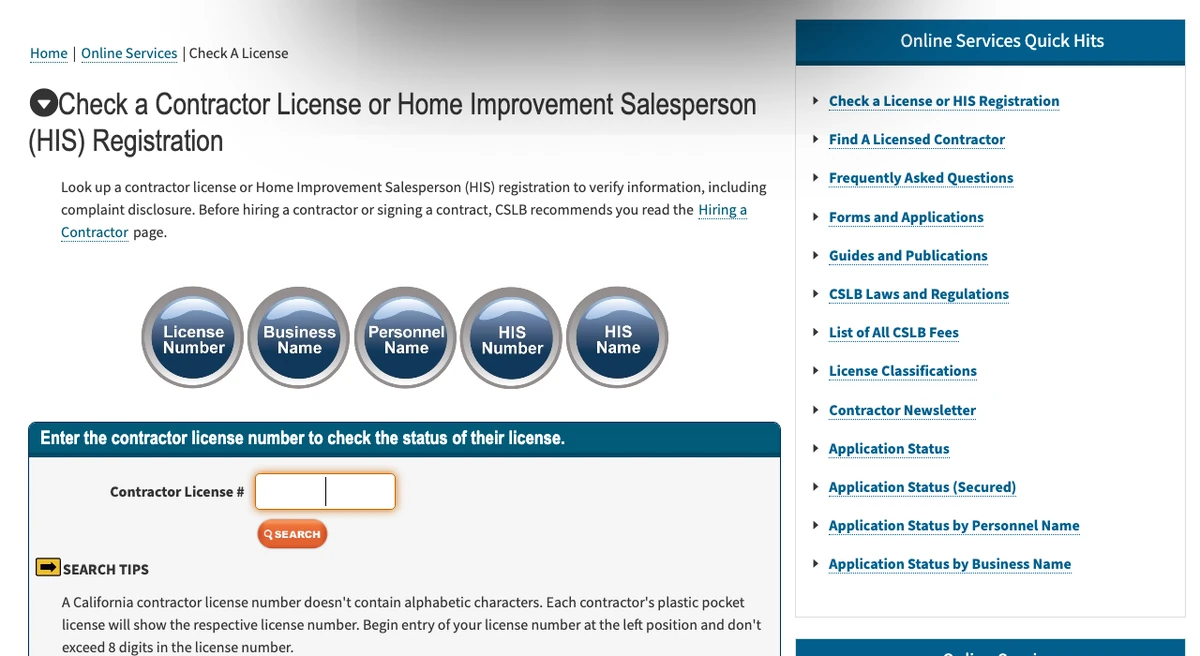
- Put your license number on the page, with the lookup link. In California that is the board's free license check. Other states have their own. Tell the reader to look you up, and show them where.
- State your deposit rule. Write your real deposit and when each payment is due. Put your state's limit right next to it if your state has one.
- Show a real photo report. Use one from a past job, with the homeowner's OK and no house number or plate in frame. Each photo gets one plain line under it.
- Show a sample estimate. Line items, your decking price per sheet, what is included, and how long the price holds.
- Say who wrote it. Put the owner or lead estimator's name and years on the page. Google's guide to helpful, people first content asks whether a page shows first hand expertise and makes clear who wrote it. The course lesson on trust signals walks through the rest.
- End with a short FAQ in the words homeowners use, and mark it up with FAQPage schema that matches the questions word for word. The schema lesson has the markup.
One Roofer Who Leads With Proof
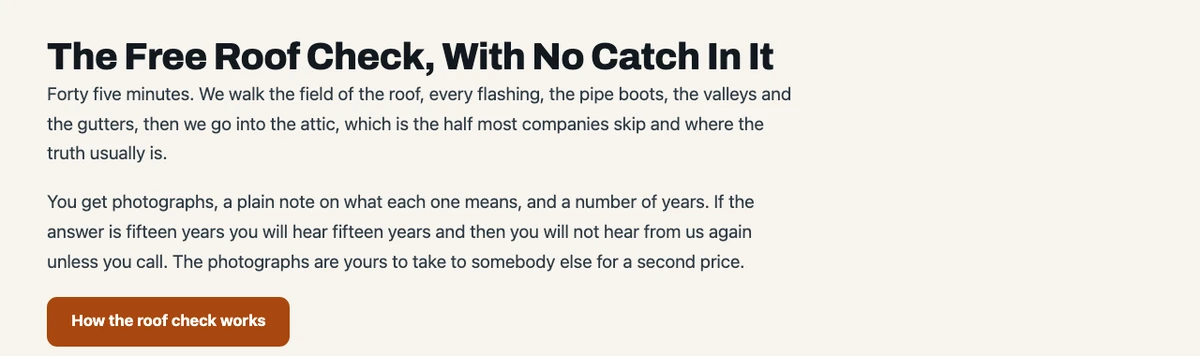
Ironbridge Roofing Co. in Davenport, Iowa, is one of the sites in this course's field notes. Its home page does what this post asks. On October 12, 2026, it described a free roof check of about 45 minutes that includes the attic. The homeowner gets photos, a plain note on each one and a number of years left on the roof. It also says the photos belong to the homeowner, to take to another roofer for a second price.
That last line is the whole idea. A liar hides the evidence. An honest roofer hands it over and invites the second opinion. No red flag list can beat that.
The same page also lists what the company refuses to do, like covering a homeowner's deductible. A short list of what you will not do is one of the strongest trust signals a roofer can publish, because a liar would never write it down.
Reviews Without Breaking the Rules
Homeowners who fear lies read reviews hard. So reviews are proof too, but only real ones. Two sets of rules apply.
- Google. The Maps content policy bans fake engagement and paid reviews. It says a business may not offer money, discounts or free work for a review. It also bans asking only your happy customers.
- The FTC. On August 14, 2024, the FTC announced a final rule banning fake reviews, paying for reviews that must be good or bad, and hiding bad reviews with threats. It says the agency can seek civil penalties against those who break it knowingly.
The fix is simple. Ask every customer, the same way, after every job. Ask them to say what you showed them. A review that says they sent photos of my attic before quoting is worth more than five stars with no words. The lesson on getting reviews every week sets up the routine.
Your One Week Plan
- Monday. Find your license lookup link and your state's deposit rule, if it has one. Write both down.
- Tuesday. Pick one past job. Get the homeowner's OK and build a clean sample photo report and estimate from it.
- Wednesday. Write the page. Answer first, the proof table second, your paperwork third, FAQ last.
- Thursday. Link it from your inspection page, your about page and your contact page, and link back.
- Friday. Publish, submit it in Search Console, and post the photo report to your Google profile.
Then leave it alone for a month. Check which page it sent people to next. That tells you what to improve.
This guide is part of the free Learn Clickflame course. Every lesson is free and uses free tools.
Questions Owners Ask
How can a homeowner tell if a roofer is lying?
Ask for proof. Photos of the damage, a written itemized price, a license number you can look up, and an insurance certificate sent by the insurer. A roofer who cannot show these, or rushes you to sign today, is the one to worry about.
How much deposit can a roofer ask for in California?
The Contractors State License Board says a down payment should never be more than 10 percent of the contract price or $1,000, whichever is less. A contractor with a blanket performance and payment bond on file with the board is the exception.
Should a roofing company put its license number on its website?
Yes, with a link to your state's license lookup. Homeowners who fear being lied to will look you up anyway. Making it easy shows you have nothing to hide.
Can a roofer give a discount for a Google review?
No. Google's Maps content policy says a business may not offer money, discounts or free work in exchange for a review. Ask every customer the same way, with nothing attached.
Is it smart for a roofer to write about roofing scams?
Yes, if the page shows your own proof instead of just a list of red flags. On October 12, 2026, five roofing company blogs were cited in Google's AI answer for this question, and most of the roofer pages we checked had no links at all.